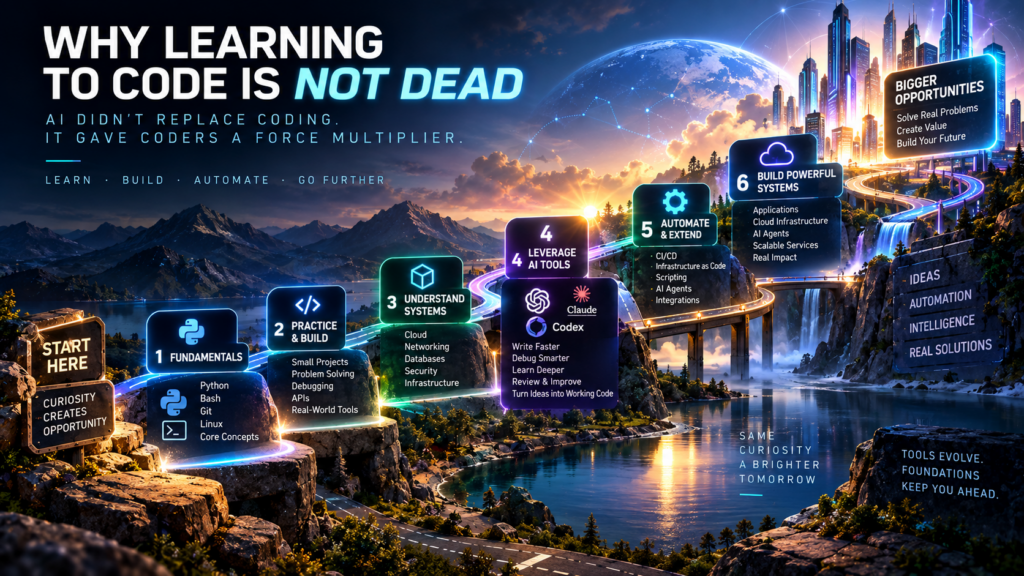
Lately, tools like Windsurf, Claude, Codex, OpenCode, Lovable, and others have become popular because they help people who do not know how to code build tools and products. They also help experienced developers move faster and deliver faster. AI tools such as ChatGPT and Claude Code can write basic code, fix errors, and generate syntax in seconds. As a result, writing individual lines of code now makes up a smaller part of a developer’s day, leaving more room for higher-level thinking, planning, and problem-solving.
Does It Still Matter If You Learn to Code?
From using these tools in my own personal projects, I have noticed that they still make mistakes. Sometimes the code is there, and it may even be syntactically correct, but it does not do what I intended. The logic may be wrong, and it can take a lot of back-and-forth prompting to get the result right.
As an engineer, I often get deep into system design, especially complex system design. In those situations, it is not enough to simply tell Claude or any other tool to build a piece of infrastructure or write code for you. You need a blueprint and a deep understanding of what you are asking it to build. These tools are powerful, but they cannot do the work alone. They need clear direction, context, and human judgment to get it right.
Security is another major concern for organizations today. It is easy to imagine building a tool that appears to work on the surface but contains serious vulnerabilities underneath. For that reason, human oversight is essential. So yes, learning to code still matters.
Why Coding Is Not Dead
To answer that question, it helps to understand what an LLM is. At a basic level, an LLM is a model with parameters. More parameters can improve reasoning and pattern recognition, but the model cannot take meaningful action on its own unless it is connected to tools. This is where people with strong technical understanding and coding ability become even more important: they can build custom tools around language models so those models can execute code, interact with systems, and accomplish useful tasks.
When you look at tools like Claude, Devin, Codex, and others, many of them function as harnesses or suites of tools built around language models such as Sonnet or GPT models. These systems give an LLM access to capabilities like editing files, running commands, searching documentation, and testing code. The better the surrounding tools are, and the better the human guidance is, the more useful the model becomes.
That raises an important question: what becomes possible, even with a smaller language model, when it is surrounded by the right tools? For me, this is where coding becomes even more exciting. When you understand how code works, using AI tools is not just easier—it becomes more powerful. You can evaluate the output, guide the tool more effectively, troubleshoot problems, and turn your ideas into products faster. Instead of blindly relying on AI, you are working with it from a place of knowledge and understanding.